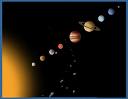
 | The Earth is one of nine planets that orbit a G-2 star, known as the Sun. The four planets closest to the Sun are solid, rock-based planets, which contain the Earth, and the final four planets are the huge, gaseous planets. Pluto has been designated a planetoid, a demotion from being a solar planet, because it has been discovered that there are many planetoids around Pluto. Below you will find out about the Sun and each of the planets that it created, around 4.5 billion years ago. The Sun and its solar system is located in the galaxy known as the Milky Way. There are believed to be billions of galaxies throughout the Universe, each containing billions of stars, that may have solar systems, which may have planets that hold life. Will we ever find out? |
The Sun
Diameter: 1.3 million km | Temperature: 5,800C
The Sun is the star that the Earth and the other eight planets orbit. It supports life on the only planet known to contain it, our own Earth, and without the Sun there would be no life at all on our planet.
The sun is mainly made up of hydrogen, as are all stars. It came into life about 5 billion years ago, and is believed to be halfway through its stage of existence, with about another 5 billion years of energy left in it.
Mercury
Diameter: 4,800 km | Distance from Sun: 57,900 km | Moons: 0
Mercury is the closest planet to the Sun, and one of the smallest too.
Temperatures vary on Mercury from 90C to over 700C, depending on how the planet is orbiting the Sun
Venus
Diameter: 12,100 km | Distance from Sun: 108.2 million km | Moons: 0
Venus was once thought to resemble Earth in its earlier time, but global warming, on a massive scale, have made the atmosphere mainly carbon dioxide, and temperatures range on the planet, with peaks at 750C, making any life there very unlikely.
Venus also has a year that is quicker than its day. This is because by the time that Venus has done a full rotation of its own orbit, it has already orbited the Sun!
Earth
Diameter: 12,750 km | Distance from Sun: 149.6 million km | Moons: 1 (Moon)
The Earth is the only planet in the Solar System, and indeed the Milky Way and the Universe, known to have organic life, including us, the human species.
It is made of mainly 90% water and 10% rock on the surface, with an iron core in the centre of the Earth's crust, which gives Earth its gravity and atmosphere. The main gases of the Earth is mainly hydrogen and oxygen, essential for life to exist as we know it on the planet.
The Earth has one orbiting satellite, the Moon, which has effects on the Earth's gravitational pull and on the oceans and seas of the world.
Earth is believed to be about 4.5 billion years old. It has only had life, as we know it, for over the 1/2 billion years, with microbes believed to be the beginning of life, through to water-based lifeforms. Life then started to evolve on land when sea creatures developed lungs to live out of water.
The Earth's rotation on its axis is just over 24 hours long, and its rotation around the Sun, its orbit, takes just over 365 Earth days, which we know as a year. The Moon takes just over 28 days to orbit the Earth, which we know as a lunar month.
